

Many leadership failures do not begin with pride in the obvious sense. They begin with a subtle belief that the work cannot continue without us.
A leader may never say it aloud. He may even appear humble. Yet deep inside, he begins to believe that he is indispensable. He sees himself as the only one who truly understands the vision. He struggles to trust others with responsibility. He feels that if he steps away, everything will fall apart.
This was one of Elijah’s greatest mistakes.
Leadership Is Taught by Example
The Bible is God’s leadership handbook. Yet it does not primarily teach leadership through commands, formulas, or management theories. It teaches leadership through the lives of men and women whose successes and failures have been preserved for our learning.
Romans 15 (KJ2000)
4 For whatever things were written before were written for our learning, that we through patience and comfort of the scriptures might have hope.
Paul tells us that the stories recorded in Scripture were written to teach us. We are meant to study them and learn from them.
Likewise:
1 Corinthians 10 (KJ2000)
11 Now all these things happened unto them for examples: and they are written for our admonition, upon whom the ends of the ages are come.
The Bible teaches leadership largely by example, not by precept. When we study the lives of biblical leaders, we discover principles that apply just as much today as they did thousands of years ago.
The story of Elijah in 1 Kings 19 contains one such lesson.
After Great Success Came Great Discouragement
Elijah had just experienced one of the most dramatic victories in the entire Bible.
On Mount Carmel, God answered his prayer by fire. Hundreds of false prophets were exposed. The nation witnessed the power of the living God. Soon afterwards, rain returned to the land after years of drought.
From a leadership perspective, Elijah was at the peak of his ministry.
Then Jezebel threatened him.
Instead of celebrating victory, Elijah fled into the wilderness. There, discouraged and exhausted, he began to see himself in a way that God did not.
1 Kings 19 (KJ2000)
10 And he said, I have been very jealous for the LORD God of hosts: for the children of Israel have forsaken thy covenant, thrown down thine altars, and slain thy prophets with the sword; and I, even I only, am left; and they seek my life, to take it away.

Notice Elijah’s assessment of the situation.
“I, even I only, am left.”
Elijah believed he was the last faithful servant of God in Israel. In his mind, the future of God’s work rested entirely on his shoulders.
That was not true.
The Danger of Thinking You Are Indispensable
Many leaders fall into exactly the same trap.
A pastor begins to believe the church cannot function without him.
A business owner becomes convinced that nobody else can make decisions correctly.
A ministry leader refuses to delegate because he assumes everyone else will fail.
A department head insists on approving every detail because he trusts nobody else.
At first glance, this may look like commitment. In reality, it often reveals a lack of trust, both in people and in God.
Whenever a leader begins to think that everything depends on him, he has started developing a Messiah complex.
He has forgotten who the real Messiah is.
God Has More People Than You Know
God’s response to Elijah was both gentle and corrective.
1 Kings 19 (KJ2000)
18 Yet I have left me seven thousand in Israel, all the knees which have not bowed unto Baal, and every mouth which hath not kissed him.
Elijah thought there was one faithful servant.
God said there were seven thousand.

Elijah was judging the situation based on what he could see. God was looking at realities that Elijah knew nothing about.
This remains true today.
You may know the people who disappointed you.
You may know the people who left.
You may know the people who failed.
What you do not know is whom God is preparing. You do not know whom God is training in secret. You do not know whom God intends to raise next.
God’s resources are always greater than your awareness of them.
God’s Work Is Bigger Than Any One Leader
After correcting Elijah’s perspective, God instructed him to anoint Elisha.
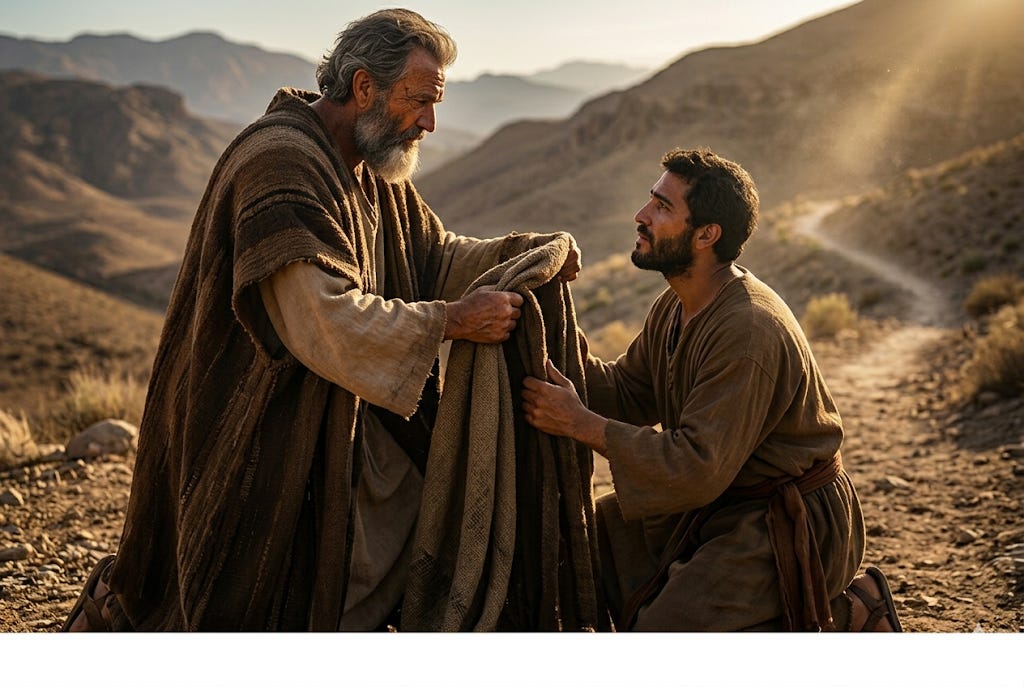
The message was unmistakable.
The work would continue.
The ministry would continue.
The purposes of God would continue.
God was reminding Elijah that His plans are not dependent upon any one individual.
Every leader is temporary.
Every position is temporary.
Every assignment is temporary.
Only God’s purposes are permanent.
One of the healthiest realisations a leader can have is this: God was accomplishing His purposes before you arrived, and He will continue accomplishing them after you leave.
Great Leaders Build Successors
One reason many organisations struggle is that leaders build dependence instead of developing successors.

They become the centre of every decision.
They keep knowledge to themselves.
They refuse to mentor emerging leaders.
They feel threatened when capable people appear.
Such leaders may remain important for a season, but they weaken the organisation they lead.
Great leaders do the opposite.
Moses prepared Joshua.
David prepared Solomon.
Paul prepared Timothy and Titus.
The greatest proof of leadership is not how much depends on you today. It is how well the work continues tomorrow.
A Leadership Lesson from Elijah
Elijah’s mistake was not his passion. His mistake was believing that he was the only person God could use.
Many leaders still make the same mistake.
Whenever you begin to think that nobody can replace you, remember God’s answer to Elijah.
You may see one person.
God sees seven thousand.
You may see scarcity.
God sees abundance.
You may think the future depends on you.
God knows better.
The Kingdom belongs to Him, not to us. Our responsibility is not to become indispensable. Our responsibility is to be faithful, develop others, and leave the work stronger than we found it.
Continue in grace!