

The Book of Esther preserves for us the dramatic story of Haman. It is a story of ambition, power, obsession, and ultimate downfall. Haman was promoted to one of the highest offices in the Persian Empire, yet he lost everything because he allowed hatred for one man to consume him.
The apostle Paul reminds us:
1 Corinthians 10 (KJ2000)
11 Now all these things happened unto them for examples: and they are written for our admonition, upon whom the ends of the ages are come.
In other words, the Bible does not tell us Haman’s story for history’s sake alone. It is written for our learning, that we might guard our own hearts and not repeat his mistakes.
Haman’s Rise to Power
Whatever his background, the defining moment of Haman’s life came when King Ahasuerus promoted him above all the other princes and placed him next to the throne (Esther 3:1). By royal decree, all the king’s servants were commanded to bow and give him honour.
This was no small privilege. Haman enjoyed wealth, honour, and authority on a scale few men ever taste. He had the ear of the king and the fear of the empire. But position and privilege did not bring peace. For all his power, Haman remained restless.
The Mordecai Problem
At the king’s gate sat a man named Mordecai, a Jew. Mordecai refused to bow to Haman. Scripture does not suggest that Mordecai was disrespectful or defiant — he simply could not offer to a man the reverence that belonged to God alone.
That small act was enough to enrage Haman.
Esther 3 (KJ2000)
5 And when Haman saw that Mordecai bowed not, nor paid him homage, then was Haman full of wrath.
Here we are reminded of Paul’s words again:
Romans 15 (KJ2000)
4 For whatever things were written before were written for our learning, that we through patience and comfort of the scriptures might have hope.
Mordecai’s refusal and Haman’s response are not random details. They are lessons for us. They show how a leader can have everything yet count it all as nothing because of one person’s resistance.
The Danger of Obsession
Haman himself confessed this in tragic words: “Yet all this avails me nothing, so long as I see Mordecai the Jew sitting at the king’s gate” (Esther 5:13).
Think about that. Haman had honour, riches, power, and the favour of the king. But in his own eyes, it all meant nothing because one man refused to bow.
This is the danger of obsession. Leaders fall into the same trap today. A pastor can have hundreds of members but lose sleep over the one family that leaves. A business owner can have hundreds of satisfied customers, but brood endlessly over the one who complains. A politician can have broad support but fixate on a single critic.
The danger is not the “Mordecai” in your life—it is the Haman-like spirit that cannot let go.
Hatred That Spilled Over
Haman’s anger quickly grew out of proportion. It was not enough for him to punish Mordecai. He determined to destroy all of Mordecai’s people—the Jews. He manipulated the king into decreeing their extermination.
This is what happens when bitterness is left unchecked. It never remains private. It spills into your decisions, infects your leadership, and hurts those who are innocent. What began as one man’s offense became a genocidal policy. That is how far pride and wrath can take a leader who refuses to master his spirit.
God’s Reversal
But God was not absent. Mordecai had earlier uncovered a plot against the king, and though his deed had been recorded, it had not been rewarded. On the very night before Haman intended to request Mordecai’s execution, the king could not sleep. In God’s providence, the chronicles were read, and Mordecai’s loyalty came to light.

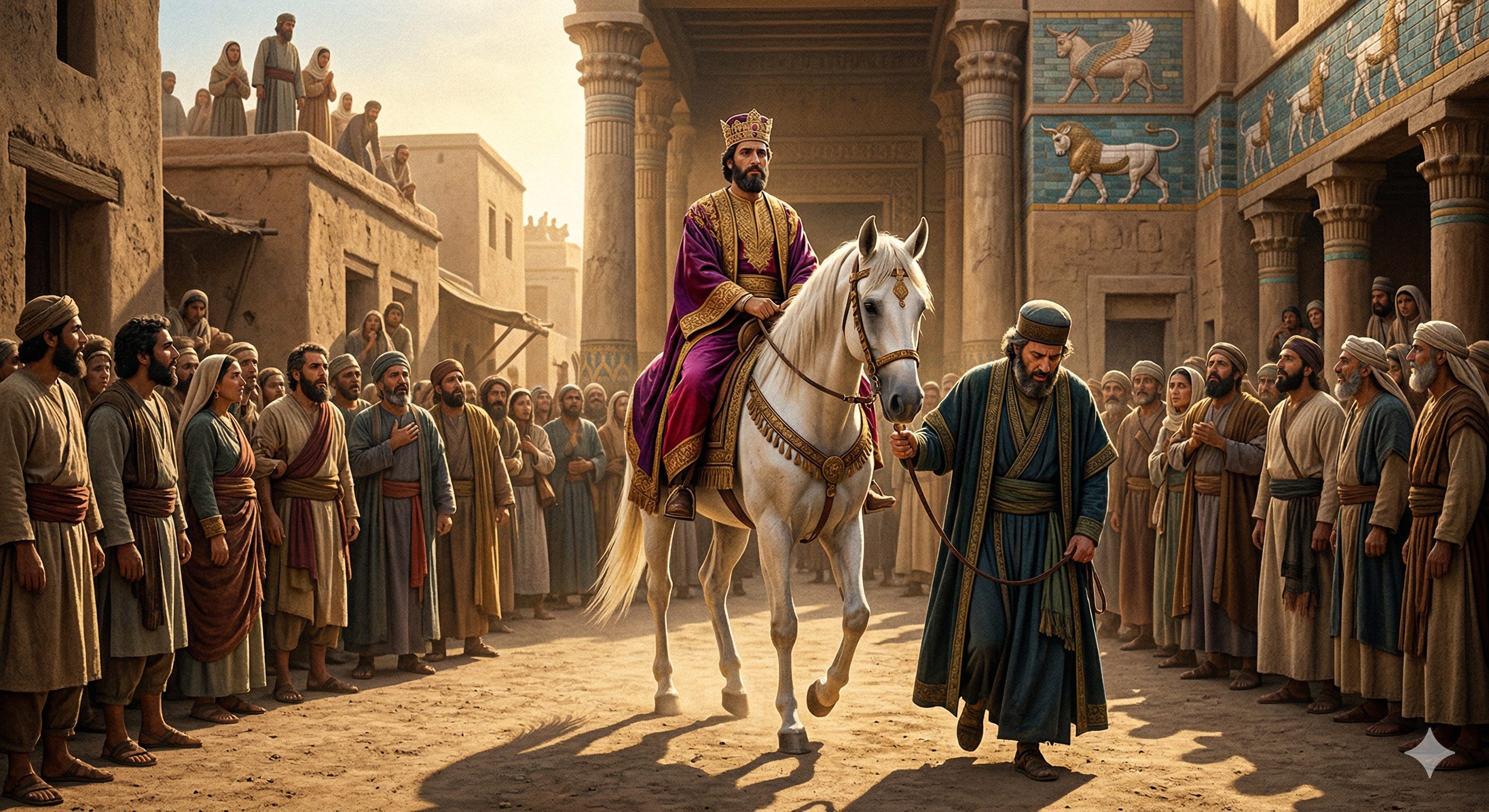
Ironically, it was Haman who was commanded to honour Mordecai publicly. The man who came to destroy him was forced to lead him through the city, proclaiming his greatness. What humiliation for Haman! Yet it was also a turning point, showing that God can reverse the schemes of the proud in a moment.
The Gallows He Built
Encouraged by his wife and friends, Haman had built a gallows fifty cubits high on which to hang Mordecai. But in a stunning twist of divine justice, those same gallows became the instrument of Haman’s death. When Queen Esther revealed his wicked plot, the king’s wrath was kindled, and Haman was hanged on the very gallows he had prepared for another (Esther 7:10).
The lesson is sobering: the snares we set for others often become the snares that trap us. Leaders who scheme, manipulate, or dig pits for others eventually fall into them themselves.
Lessons for Leaders
Learn Gratitude.
Haman’s downfall began with discontent. Leaders must learn to count their blessings instead of magnifying their slights.Do Not Let Critics Dominate You.
Mordecai was not Haman’s real problem—Haman’s ego was. Leaders who let one critic define their vision are already on the path to ruin.Beware of Overreaction.
One man’s refusal led Haman to plot genocide. Leaders must keep perspective, or else small slights will lead to destructive decisions.Pride Precedes Destruction.
Haman’s pride made him fragile. Scripture warns us that “Pride goes before destruction, and a haughty spirit before a fall” (Proverbs 16:18).God’s Justice Is Sure.
The gallows testify that wickedness boomerangs. Leaders who walk in integrity will outlast those who thrive on manipulation.
Conclusion: Don’t Be a Haman
Haman’s story shows how quickly a man can have everything yet lose it all because of pride and obsession. He could not enjoy his blessings because he was blinded by one man’s refusal. He allowed hatred to consume him, and it destroyed him.
Leaders today must take heed. Don’t let your “Mordecai” rob you of joy. Don’t allow one critic, one rival, or one disappointment to erase the goodness of God in your life. If you do, you risk ending up like Haman—a man who had everything but lost it all.
Let us instead learn from these things, for as Scripture says, “whatsoever things were written aforetime were written for our learning, that we through patience and comfort of the scriptures might have hope” (Romans 15:4).
Continue in grace!
