

Joshua and Caleb did not lack faith, courage, conviction, or vision. Yet they waited forty years to enter the Promised Land.
That is a serious leadership lesson.
Sometimes, delay does not come because you are wrong. Sometimes, delay comes because you are joined to the wrong people.
Joshua and Caleb were ready for Canaan. Their team was not. They had the right report. Their team had the wrong spirit. They had faith. Their team had fear. They were prepared to move. Their team wanted to return to Egypt.
So, Joshua and Caleb waited.
The delay was not personal failure. It was team failure.
That should make every leader careful.
The Story Was Written for Our Learning
1 Corinthians 10 (KJ2000)
11 Now all these things happened unto them for examples: and they are written for our admonition, upon whom the ends of the ages are come.
The wilderness story is not a tale for children. It is instruction for leaders.
It teaches us how people respond to pressure. It teaches us how fear spreads. It teaches us how reports shape culture. It teaches us how a whole people can stand near promise and still turn back.
Israel had seen God’s power. They saw the plagues in Egypt. They saw the Red Sea open. They ate manna. They drank water from the rock. They followed the pillar of cloud by day and fire by night.
Yet, when they reached the border of Canaan, they believed fear more than they believed God.
That is the danger of wrong voices.
They Saw the Same Land
Moses sent twelve men to search the land of Canaan. These were not random men. They were leaders.
Numbers 13 (KJ2000)
3 And Moses by the commandment of the LORD sent them from the wilderness of Paran: all those men were heads of the children of Israel.
That detail matters.
The wrong people were not outside the structure. They were inside it. They had office. They had access. They had influence. They had the trust of the people.
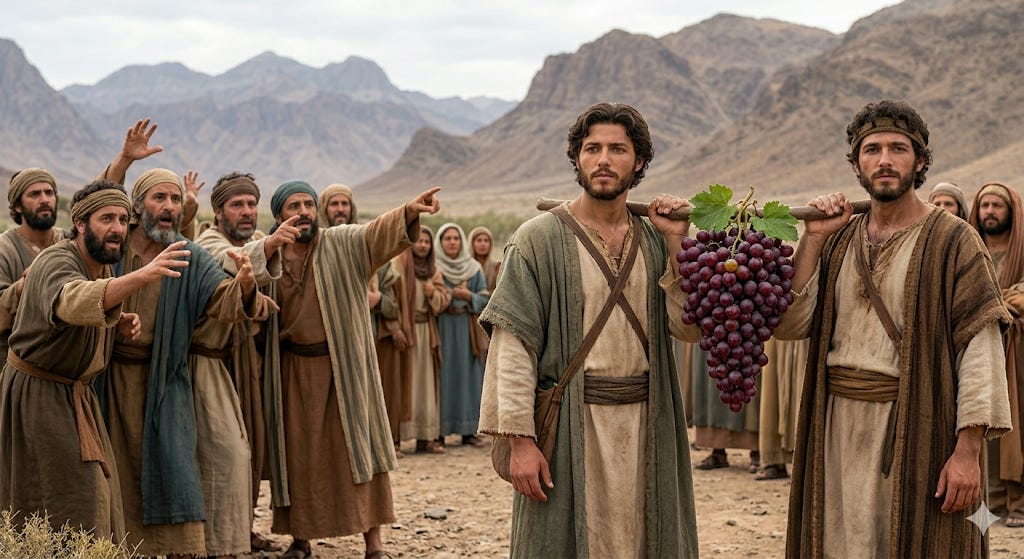
They all saw the same land. They all saw the same fruit. They all saw the same cities. They all saw the same giants. But they did not return with the same report.
Ten men saw giants and forgot God. Joshua and Caleb saw giants and remembered God.
Numbers 13 (KJ2000)
30 And Caleb stilled the people before Moses, and said, Let us go up at once, and possess it; for we are well able to overcome it.
Caleb did not deny the facts. He did not say there were no giants. He did not say the cities were not walled. He did not pretend the assignment was easy.
He simply refused to interpret the assignment without God.
That is faith.
Faith does not deny reality. Faith gives God His proper place in reality.
A Wrong Report Can Poison the Room
The ten spies gave an evil report.
Numbers 13 (KJ2000)
31 But the men that went up with him said, We are not able to go up against the people; for they are stronger than we.
That sentence changed everything.
They did not only say the land was hard to take. They said Israel could not take it.
That is where many teams fail.
It is one thing to say, “This will be difficult.” It is another thing to say, “This cannot be done.”
The first may be wisdom. The second may be unbelief.
Leaders must know the difference.
A good report does not hide problems. A good report tells the truth without killing faith. A bad report can poison the room. It can make strong people weak. It can make ready people afraid. It can make a whole team retreat from what God has already given.
This is why leaders must be careful who writes the report.
Reports are not neutral. They carry spirit.
The Congregation Chose Fear
Israel believed the wrong report.
Numbers 14 (KJ2000)
1 And all the congregation lifted up their voice, and cried; and the people wept that night.
They were close to Canaan, but they cried like defeated people.
Fear changed the atmosphere.
Fear made them forget deliverance. Fear made Egypt look safe. Fear made slavery look better than promise. Fear made them speak against Moses. Fear made them question God’s purpose.
They even wanted a new leader who would take them back to Egypt.
Numbers 14 (KJ2000)
4 And they said one to another, Let us make a captain, and let us return into Egypt.
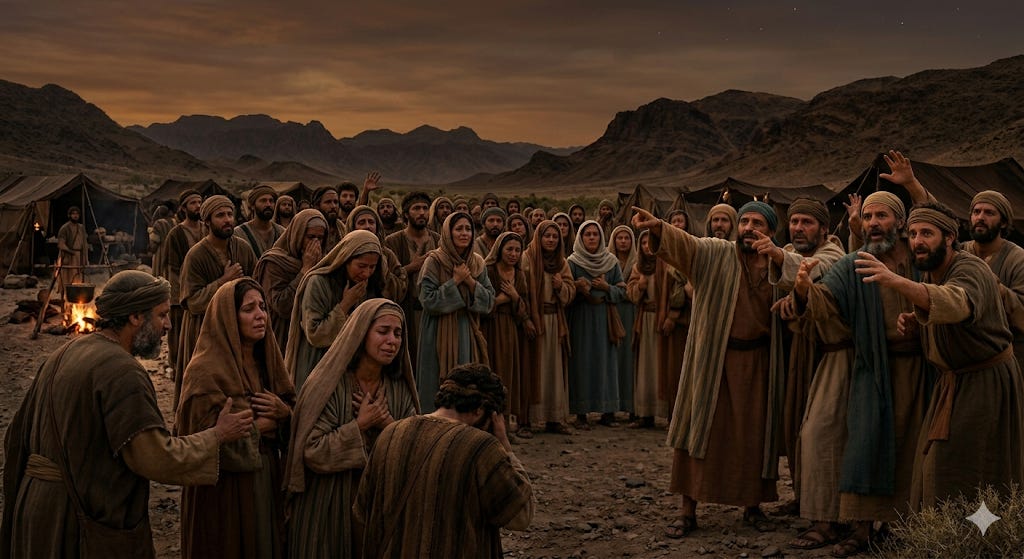
That is what fear does.
It does not only resist the future. It romanticises the past. It makes people prefer familiar bondage to unfamiliar obedience.
Many teams do this.
They say they want growth, but they resist the decisions growth requires. They say they want change, but they defend the culture that keeps them small. They say they want Canaan, but their hearts still trust Egypt.
You cannot build the future with people who are emotionally tied to the past.
Joshua And Caleb Tried to Correct the Culture
Joshua and Caleb did not keep quiet.
Numbers 14 (KJ2000)
6 And Joshua the son of Nun, and Caleb the son of Jephunneh, who were of them that searched the land, tore their clothes:
7 And they spoke unto all the company of the children of Israel, saying, The land, which we passed through to search it, is an exceeding good land.
They tried to correct the atmosphere. They reminded the people that the land was good. They reminded them that the Lord was able to bring them in. They warned them not to rebel against God.
Numbers 14 (KJ2000)
8 If the LORD delight in us, then he will bring us into this land, and give it to us; a land which flows with milk and honey.
9 Only rebel not you against the LORD, neither fear you the people of the land; for they are bread for us: their defense is departed from them, and the LORD is with us: fear them not.
Joshua and Caleb were not reckless. They were not noisy optimists. They were not ignoring risk.
They simply knew that God was with them.
That was the difference.
The ten spies interpreted the land from fear. Joshua and Caleb interpreted the land from covenant.
The people did not receive it.
Numbers 14 (KJ2000)
10 But all the congregation said to stone them with stones. And the glory of the LORD appeared in the tabernacle of meeting before all the children of Israel.
This is a hard leadership lesson.
Sometimes the people you try to help will attack you because you refuse to agree with their fear.
They may call your faith pride. They may call your courage foolishness. They may call your obedience insensitivity.
But if God has spoken, do not let the crowd edit your obedience.
They Were Right, But They Still Waited
Joshua and Caleb were right.
God confirmed it.
Numbers 14 (KJ2000)
24 But my servant Caleb, because he had another spirit with him, and has followed me fully, him will I bring into the land in which he went; and his descendants shall possess it.
Caleb had another spirit.
That phrase matters.
He did not merely have a different opinion. He carried a different spirit.
The ten spies carried fear. Caleb carried faith. The ten spies saw themselves as grasshoppers. Caleb saw Israel as able. The ten spies saw giants as the end of the story. Caleb saw giants as the next victory.
Joshua also survived.
Numbers 14 (KJ2000)
38 But Joshua the son of Nun, and Caleb the son of Jephunneh, who were of the men that went to search the land, lived still.
They lived. But they waited.
They did not die in the wilderness, but they walked in it. They did not lose the promise, but they lost time. They did not miss Canaan, but they had to wait for a generation that should have entered with them to pass away.
That is sobering.
A man can be right and still be delayed by the people he is joined to.
A leader can be ready while his team is not ready. A vision can be valid while the people carrying it lack faith. A promise can be real while the company around it lacks courage.
Wrong Team Members Waste Time
The wrong team can turn a short journey into a long wilderness.
They waste time. They drain strength. They create needless battles. They turn obedience into debate. They turn movement into meetings. They turn instruction into argument. They turn faith into endless analysis.
They make leaders spend years solving problems that should never have existed.
Joshua and Caleb should have entered Canaan much earlier. But they belonged to a nation that refused to move when God said move.
This is why team selection matters.
This is why leadership appointments matter.
This is why culture matters.
This is why you must not give influence only because a person is gifted, senior, available, familiar, or popular.
The ten spies were leaders. That made their unbelief more dangerous.
A fearful leader does not fear alone. He spreads fear. A doubtful leader does not doubt alone. He multiplies doubt. A leader with an evil report can turn a whole people against the will of God.
Be Careful Who Gets A Voice
Every team has voices.
Some voices build faith. Some voices spread fear. Some voices make people bold. Some voices make people small. Some voices clarify the assignment. Some voices confuse the people. Some voices prepare people to obey. Some voices prepare people to retreat.
Be careful who gets a voice in a critical season.
The person who explains the problem can shape how people respond to it. The person who presents the report can determine whether people see the future with faith or fear.
The ten spies did not merely give information. They gave interpretation.
Their interpretation was wrong. Their wrong interpretation delayed a whole nation.
Leaders must watch this.
Do not allow people who lack faith for the future to define the future for everybody else.
The Giants Were Not The Real Problem
The giants did not stop Israel.
The walled cities did not stop Israel. The sons of Anak did not stop Israel. The land did not refuse Israel.
Their unbelief stopped them.
That should make every leader tremble.
Many times, the greatest threat to a vision is not outside the camp. It is inside the team.
It is not the economy. It is not the opposition. It is not the size of the assignment. It is not the strength of the competition.
It is the unbelief of the people who should carry the vision.
God had already given the land. The people refused to enter it.
So a promise can be available and still not be possessed. A door can be open and still not be entered. A season can be ready and still be wasted.
Not because God failed.
Because people refused to believe.
Ask Hard Questions About Your Team
Leaders must ask hard questions.
Can this person believe God? Can this person carry pressure without spreading panic? Can this person tell the truth without killing faith? Can this person see problems without surrendering to them? Can this person disagree without destroying confidence?
Can this person interpret difficulty correctly? Can this person follow fully? Can this person say, “We are well able,” when others say, “We cannot”?
You do not need reckless people. You do not need noisy people. You do not need people who deny problems.
You need people who see God clearly enough to interpret problems correctly.
That is different.
Caleb was not careless. Joshua was not foolish. They saw the land. They saw the giants. They saw the risk.
But they also remembered the God who sent them.
That is the kind of person you want on your team.
Caleb Still Wanted The Mountain
Forty-five years later, Caleb still wanted what God promised him.
Joshua 14 (KJ2000)
10 And now, behold, the LORD has kept me alive, as he said, these forty and five years, even since the LORD spoke this word unto Moses, while the children of Israel wandered in the wilderness: and now, lo, I am this day eighty and five years old.
11 As yet I am as strong this day as I was in the day that Moses sent me: as my strength was then, even so is my strength now, for war, both to go out, and to come in.
12 Now therefore give me this mountain, of which the LORD spoke in that day; for you heard in that day how the Anakim were there, and that the cities were great and fortified: if so be the LORD will be with me, then I shall be able to drive them out, as the LORD said.
Caleb did not spend his old age complaining about the delay.
He still wanted the mountain.
His faith did not expire. His courage did not reduce. His appetite for inheritance did not die.
That is powerful.
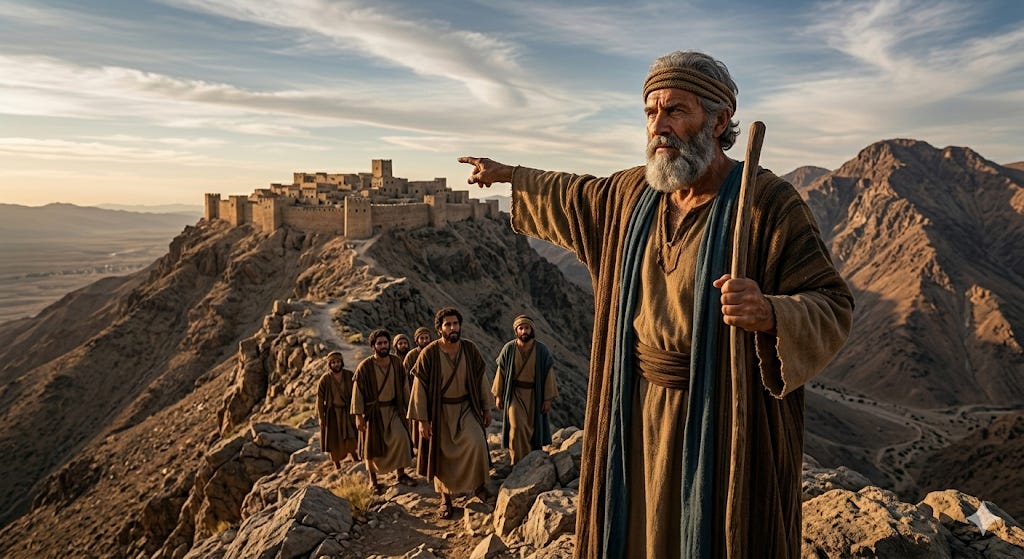
But forty years is still forty years.
Delay has a cost.
Even when God preserves you, time wasted by wrong people is still time you cannot recover.
That is why you must be careful who you build with.
Choose People with Another Spirit
Do not only ask if a person is talented.
Ask what spirit they carry.
Do not only ask if they are experienced.
Ask what report they give under pressure.
Do not only ask if they are available.
Ask whether they can help the assignment move forward.
Do not only ask if they have been around for years.
Ask whether they still believe God for the future.
Some people have experience, but no faith. Some have titles, but no courage. Some have history, but no hunger. Some have access, but no alignment. Some have position, but no obedience.
You need people with another spirit.
You need people who follow God fully. You need people who do not forget God’s promise when they see giants. You need people who can face facts without bowing to fear.
The Right People Help You Enter
The wrong people can make you wait outside what God has already given.
The right people help you enter.
Choose carefully. Pray carefully. Appoint carefully. Listen carefully.
Do not give strategic influence to people who reduce faith in the room. Do not build the future with people who still trust Egypt. Do not enter a critical season with people who interpret every giant as a reason to retreat.
The Promised Land was real. The fruit was real. The giants were real.
But God was also real.
Joshua and Caleb knew this.
The tragedy is that they waited forty years because the people around them refused to believe it.
Sometimes, Joshua and Caleb wait, not because they lack faith, but because they have the wrong team members.
Continue in grace!